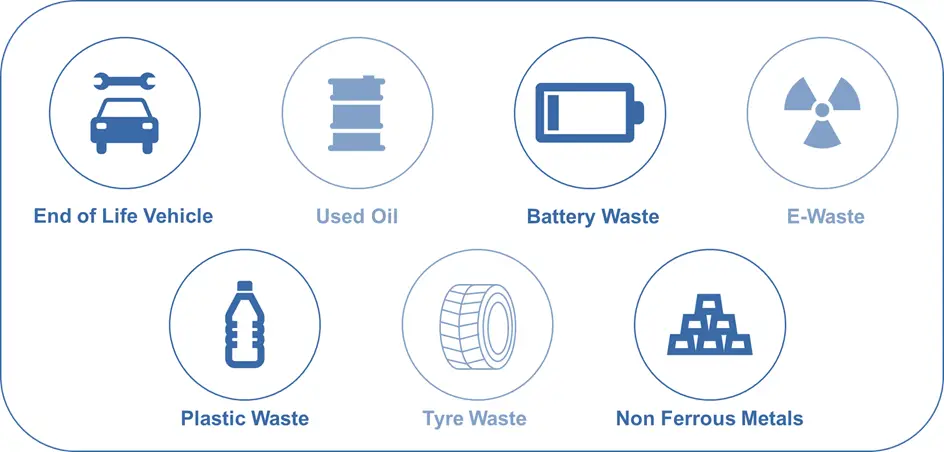
India’s rapid economic growth and urbanisation have accelerated motorisation, creating a surge in demand for raw materials and generating complex automotive waste streams. Seven categories stand out for their direct link to the automobile sector: End-of-Life Vehicles (ELVs), Used Oil, Non-Ferrous Metals, Battery Waste, E-Waste, Plastic Waste, and Tyre Waste. These streams pose environmental and health risks if mismanaged, yet they also contain valuable secondary raw materials such as steel, aluminium, copper, rare earths, plastics, and hydrocarbons making them critical for resource security and industrial growth.

To address these challenges, the Government of India has introduced Extended Producer Responsibility (EPR) frameworks, shifting accountability for waste management to producers, importers, and brand owners. This marks a transition from the traditional “take–make–dispose” model to a circular economy where products are designed for durability, collected responsibly at end-of-life, and recycled through formal systems. Key enablers such as CPCB’s digital EPR portals, certificate trading systems, and recycled-content mandates are driving this systemic change, ensuring that waste becomes a resource rather than a liability.
Conclusion


Managing automotive waste streams effectively is more than compliance it’s an opportunity to create green jobs, enhance industrial competitiveness, and secure critical resources for the future. By embracing circular economy principles and leveraging EPR frameworks, India can transform its automotive sector into a model of sustainability and innovation. The future of mobility is not just about moving people it’s about moving toward a cleaner, greener, and more resilient planet.

1. End-of-Life Vehicles (ELV)

Government policy interventions form the backbone of ELV management, particularly through EPR regulations. These policies assign responsibility for collection, recycling, and recovery to producers while enabling a transparent and accountable recycling ecosystem. India has recently made significant progress by notifying its first dedicated ELV rules. India’s regulatory journey began with the release of the draft Environment Protection (End-of-Life Vehicles) Rules on 30 January 2024, inviting stakeholder feedback. This consultation paved the way for the final notification on 06 January 2025, which introduced mandatory compliance and formalized EPR obligations for ELVs.

Conclusion


ELV related Notifications and Targets

Year Notification / Rule Key Features Targets / Obligations
2025 Environment Protection (End-of-Life Vehicles) Rules, MoEFCC (06 Jan 2025) Formal EPR obligations for producers. ELV collection centres and authorized dismantlers mandated. Recycling to meet recovery standards. Producers must meet annual ELV scrapping targets starting 2025–26 and file annual returns on the CPCB portal, while ELV owners must deposit vehicles at designated centres or RVSFs within 180 days.

2. Used Oil

Policy instruments (HOWM Rules amendments, CPCB portals, and related circular economy action plans) set the legal obligations and operational mechanisms for used-oil management. India has moved from guidance and piecemeal controls toward full EPR inclusion of used oil, including digital tracking, certificate systems and market mechanisms.

Conclusion


Used Oil-related Notifications and Targets

Year Notification / Rule (Short Title) Authority Key Features / Obligations Targets (as stated)
2016 Hazardous & Other Wastes (Management & Transboundary Movement) Rules, 2016 (Base) MoEFCC Establishes base hazardous waste regulatory framework and sets treatment standards and authorization basics.
18 Sep 2023 Hazardous & Other Wastes (Management & Transboundary Movement) Second Amendment Rules, 2023 MoEFCC Introduces Extended Producer Responsibility (EPR) for used oil under Chapter VII and mandates registration of producers, importers, recyclers, and collection agents on a CPCB portal. Establishes portal-based returns, manifest system, and compliance requirements. Enables prohibition of informal unsafe disposal. Obligated producers / importers must meet EPR obligations by purchasing EPR certificates from registered recyclers, as required under G.S.R. 677(E).
12 Mar 2024 Hazardous & Other Wastes (Management & Transboundary Movement) Amendment Rules, 2024 MoEFCC Inserted provisions for a trading platform for sale / purchase of EPR certificates (market-based compliance) and relaxed filing timelines for certain central filings. Enables market compliance and supports flexible target fulfilment.
12 Nov 2024 Hazardous & Other Wastes (Management & Transboundary Movement) Second Amendment Rules, 2024 MoEFCC Gazette Notification G.S.R. 698(E) substitutes “Prosecution” with “Action for contravention” in Rule 40 and Rule 11 of the 2016 Rules and aligns enforcement wording across the Rules. Strengthens enforcement clarity and penalties / action provisions retained.

3. Battery waste

India has made significant regulatory progress in managing battery waste. The introduction of the Battery Waste Management Rules, 2022 was a landmark step, later followed by amendments to streamline compliance with timelines and recycled-content mandates.

Conclusion


Battery waste related Notifications and Targets

Year Notification / Rule Authority Key Features Targets / Obligations
May 2001 Batteries (Management and Handling) Rules, 2001 MoEFCC First regulatory framework for Lead Acid Batteries; mandated collection and recycling by manufacturers, dealers, and recyclers. Producers and dealers required to collect used batteries and ensure recycling through registered recyclers.
Mar 2010 Amendment to Batteries Rules MoEFCC Strengthened provisions for registration, reporting, and compliance, including tighter obligations for manufacturers, importers, dealers, and recyclers. Required half-yearly returns and stricter compliance for collection and channelisation to registered recyclers.
Jul 2016 Hazardous and Other Wastes (Management & Transboundary Movement) Rules, 2016 MoEFCC Included Lead Acid Batteries under hazardous waste tracking and movement. Required manifest system and authorization for transport and disposal.
Aug 2022 Battery Waste Management (BWM) Rules, 2022 MoEFCC Replaced 2001 rules; introduced Extended Producer Responsibility (EPR) for all battery types (portable, automotive, EV, industrial). Mandatory registration of producers on CPCB portal and environmentally sound collection and recycling. Producers must ensure collection and recycling of waste batteries equivalent to quantities placed on the market. Obligations apply to all categories.
Nov 2023 First Amendment to Battery Waste Management Rules, 2022 MoEFCC Amended definitions (“battery”, “producer”); added EPR for pre-consumer waste; mandated display of EPR registration number; enabled electronic trading platforms for EPR certificates; producer registration valid until suspended or withdrawn. Progressive collection obligations starting 2024–25.
Apr 2024 Battery Waste Management (Second Amendment) Rules MoEFCC Proposed phased introduction of recycled-content obligations for new batteries. Initially 5–20% recycled content in battery manufacturing, phased to 30–40% by 2030.
Jul 2024 MoEFCC Order on Annual Return Extension (10 July 2024) MoEFCC Official order extending deadline for filing Annual Returns under BWM Rules, 2022 for FY 2023–24 to 30 Aug 2024, upon CPCB request. Recycled-content compliance deferred to FY 2027–28.

4. E-Waste (Electronic Waste)

India’s regulatory approach to e-waste has evolved rapidly in recent years, culminating in the E-Waste (Management) Rules, 2022, supported by CPCB’s EPR portal and subsequent targeted amendments to operationalise trading, timelines and technical clarifications. The table below summarises the key notifications and amendments (dates and major features) you should cite in the concept paper.

Conclusion


Electronic waste related Notifications and Targets

Year / Date Notification / Amendment Authority Key Features Targets / Obligations
02 Nov 2022
(implemented 01 Apr 2023)
E-Waste (Management) Rules, 2022 MoEFCC / CPCB Expanded scope (106 EEE categories), mandatory registration of producers/importers/brand owners (PIBOs), take-back obligations, mandatory recycling via authorised recyclers, CPCB EPR portal for registration & certificates. Producers liable to meet collection & recycling obligations corresponding to quantities placed on the market; specific product-wise recycling targets set in the Rules.
24 Jul 2023 Amendment to E-Waste Rules, 2022 MoEFCC Clarifications on refrigerant management for refrigeration/AC manufacturing and end-of-life; exemptions for certain pre-existing EEE & parts (time-bound). Operational clarifications; exemptions (only to RoHS-related parts) with deadlines.
08 Mar 2024 Amendment (EPR certificate trading & timelines) MoEFCC / CPCB Inserted provisions for a trading platform for sale/purchase of EPR certificates and relaxation in timelines for filing of returns; strengthens market-based compliance. Enables producers to meet shortfalls by purchasing verified EPR certificates from recyclers/others.
12 Nov 2024 Amendment (Prosecution → Action for Contravention) MoEFCC Substitutes “prosecution” provisions with “Action for Contravention” aligning with amended Environment (Protection) Act; refines enforcement approach. Retains penalty enforcement but modifies legal procedure.

5. Plastic Waste

India has been proactive in regulating plastic waste, introducing progressive amendments to the Plastic Waste Management Rules and implementing one of the most advanced EPR frameworks globally. The table below summarises the notifications and obligations in detail.

Conclusion


Plastic waste related Notifications and Targets

Year / Date Notification / Amendment Authority Key Features Targets / Obligations
2016 Plastic Waste Management Rules, 2016 MoEFCC Laid down responsibilities for local bodies, producers, importers, and brand owners (PIBOs); mandated collection and channelisation of plastic waste. Producer responsibility introduced but not fully operationalised.
2018 PWM (Amendment) Rules, 2018 MoEFCC Strengthened definitions, responsibility on waste generators, phase-out of certain multi-layered plastics. Producers to establish collection systems through modified registration procedures.
Aug 2021 PWM (Amendment) Rules, 2021 MoEFCC Notified phasing out of identified single-use plastics (SUPs) by July 2022. Ban on manufacture, sale, and use of certain SUP items.
Feb 2022 Plastic Waste Management (Amendment) Rules, 2022 MoEFCC Comprehensive EPR Guidelines for Plastic Packaging; categories defined:
  • Rigid plastics
  • Flexible plastics (single layer & multilayer)
  • Multilayered packaging
  • Compostable plastics
Introduced mandatory minimum recycled content.
Obligated PIBOs to achieve annual recycling targets linked to quantities introduced; recycled content targets for plastic packaging (30%–60% phased).
July 2022 Single use Plastic (SUP) Ban Implementation MoEFCC Ban on identified SUP items enforced from 1 July 2022. SUP phase-out obligation.
2023 Amendment to PWM Rules, 2022 MoEFCC Clarifications on reporting timelines, definitions, and portal use Continued obligations through CPCB’s EPR portal.

6. Tyre Waste

Recognising the scale of waste tyre generation, India has introduced targeted EPR rules under the Hazardous and Other Wastes framework, later integrated into MoEFCC’s EPR architecture. Below is the summary of notifications and obligations.

Conclusion


Tyre waste related Notifications and Targets

Year / Date Notification / Amendment Authority Key Features Targets / Obligations
July 2022 Hazardous & Other Wastes (Management & Transboundary Movement) Amendment Rules, 2022 (EPR for Waste Tyres) MoEFCC Introduced EPR for waste tyres, mandatory registration of producers, recyclers, retreaders on CPCB’s portal. Introduced tradable EPR certificates for processed tyres. Producers/importers of tyres must ensure environmentally sound management of ELTs equivalent to the quantity they introduce.
2023 CPCB EPR Portal for Tyres CPCB Online registration, certificate generation, and trading platform. Producers must achieve annual recycling/recovery targets through purchasing EPR certificates.